Ten Minutes

Sunday began the way many Sundays do. I stopped at Trader Joe’s before driving to Chastain Park so Angel could have a quick potty break before we headed home. Chastain has been part of my weekly routine for years. I play tennis there three mornings a week and often have breakfast afterward at The Chastain. I know the courts, the walking paths, and the rhythm of the parking lot well enough that I never thought to be guarded there.
Angel usually travels with her stroller because I take her into stores with me. She is fifteen, but she still has stamina and stops for every patch of grass and unfamiliar scent. Since we were making a brief stop, I left the stroller in the truck, picked her up, and carried her toward the grass.
My purse and tote were on the passenger-side floorboard, and we were away from the truck for less than ten minutes. When I returned and opened the passenger-side door, both bags were gone. I looked beneath the seat, checked the back, and glanced across the console, although I knew exactly where I had left them. For several seconds, I searched for an explanation that would allow me to avoid the one in front of me. There was no broken glass on the pavement and no visible damage to the truck. The door and window appeared untouched, and nothing about the scene suggested that someone had opened my truck and taken two bags while Angel and I stood only a short distance away.
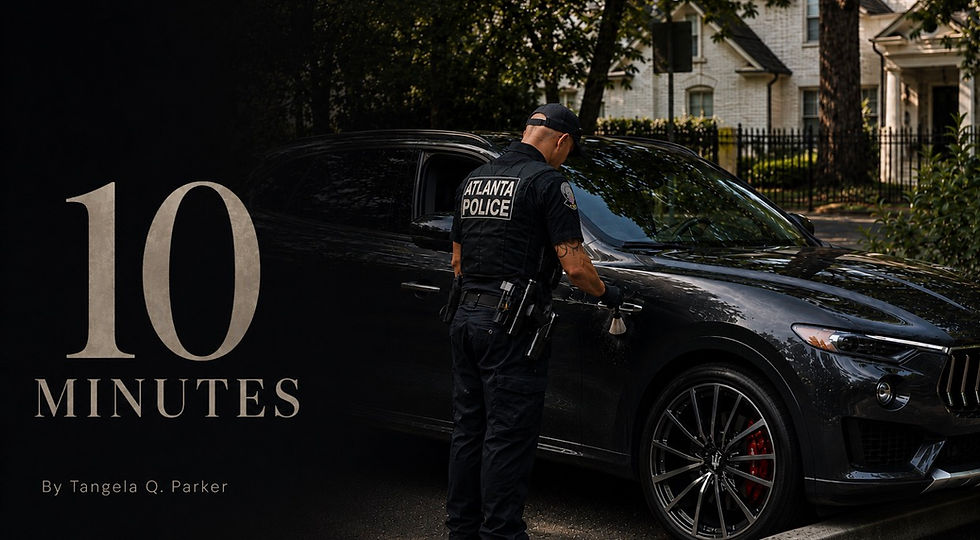
The rest of the park looked the same. People walked their dogs, carried tennis bags across the parking lot, and talked beside their cars. While Angel wandered through the grass, absorbed in whatever had captured her attention, someone had watched my truck closely enough to act and leave before we returned. I called 911, and an Atlanta police officer arrived to take the report. He dusted the door and window for fingerprints, and several appeared as the powder settled across the surface. There was no way to know who had left them or whether they would lead anywhere.
The officer asked me to describe what had been taken. I began with my wallet, driver’s license, debit cards, credit cards, insurance cards and house keys. As I spoke, I remembered other items that had been inside the bags, including membership cards, receipts and a notebook I always carried. The notebook held the ordinary details of my life. I wrote grocery lists beside ideas for stories, notes from meetings beside reminders and prayers on pages that also contained phone numbers or errands. Some entries mattered deeply, while others would have meant nothing to anyone but me. The notebook had little financial value, but it contained words I had not stored anywhere else. When the officer completed the report, I placed Angel inside the truck and sat in the driver’s seat. The floorboard beside me was empty, and the absence of those familiar bags made the truck feel unfamiliar.
I called my dad in Mississippi because I needed to hear his voice. He could not undo what had happened, but hearing him gave me a familiar place to begin. After we spoke, I contacted the bank, canceled my cards, called State Farm, and started listing everything that would need to be replaced.
Each call uncovered another task. The driver’s license required one process, the bank cards required another, and the house keys presented a different concern. Automatic payments needed to be reviewed, accounts needed to be monitored, and passwords needed to be changed. The loss continued expanding long after I had left the parking lot. By the time I reached home, I had started a list. Whenever I thought it was complete, I remembered another card, another account or another item that had been inside one of the bags. The theft lasted only a few minutes, but addressing it would require days of calls, forms, appointments and waiting.
I have spent much of my adult life being the person who knows what to do next. My work has required composure, sound judgment and the ability to lead when situations become complicated. People often meet the finished version of that responsibility. They see the title, the experience and the confidence without seeing what it takes to maintain them when life becomes uncertain.
The past few years have included professional loss, public scrutiny, grief and the steady work of rebuilding. None of those experiences ended neatly before the next one arrived. Life continued making demands, and I continued answering them because there was always another responsibility waiting for me.
The robbery gave all of that weight somewhere to land.
A purse can hold far more than its contents. Mine carried the objects that allowed me to move through the world without thinking about them. My license identified me, my cards gave me access to my own accounts, my keys allowed me to enter my home, and my notebook held thoughts I had chosen not to share publicly. Together, they formed the practical structure of an ordinary life. Their disappearance made me think about how much identity becomes attached to the things that confirm who we are to other people. A driver’s license provides a name, photograph, and address. A business card provides a title, and a bank card opens an account. None of those objects can describe a life, but we depend on them to speak for us every day.
Who am I when those things are no longer speaking for me?
The answer was not waiting inside the police report, the insurance claim, or the list of replacement cards. It could not be mailed to me or issued at an office. It lived in the part of me that still knew how to make the next call, care for Angel, listen to my father’s voice, and ask for help without pretending the afternoon had not shaken me.
Before I left the park, I prayed. I was not asking for my belongings to be returned, nor was I searching for an explanation. I needed God’s presence more than I needed answers. My faith has grown quieter over the years. I do not spend as much time asking why. I spend more time asking God to stay close. That prayer did not change what had happened. My bags were still gone, my keys still needed to be replaced, and the uncertainty surrounding my personal information remained. Prayer gave me enough steadiness to handle what was in front of me without needing to understand all of it first.
Over the next several days, I will replace my driver’s license, wait for new cards, and continue working through the insurance claim. Those tasks come with instructions and

will eventually be completed. Chastain Park is different. It was once a familiar place where I played tennis, met friends for breakfast, and stopped with Angel without questioning whether we were safe. I will not be returning anytime soon. I know that one afternoon does not define an entire park, but I have no desire to force myself back there to prove that it does not have power over me. Angel will still expect our outings, and she will still investigate every patch of grass as though she has never encountered anything more interesting.
We will find another place for our walks and build another routine that feels ordinary.


Comments